The MacBook Charger: A Retrospective Look
Apple officially turned 50 years old on April 1, 2026, marking five decades since Steve Jobs, Steve Wozniak and Ronald Wayne founded the company in a California garage.
To celebrate this milestone, the company launched an ongoing retrospective campaign highlighting its innovations over the years. With that in mind, we examine the evolution of MacBook chargers, a journey spanning four distinct eras that reflects Apple’s balance between safety, design minimalism and charging speeds.
MagSafe (2006–2012): The Magnetic Breakthrough
Introduced with the first Intel MacBook Pro, MagSafe featured a magnetic connector that detached safely if tripped over, preventing the laptop from being pulled off a desk. The design came in T-shaped and later L-shaped connectors, with wattages varying from 45W, 60W and 85W depending on whether the laptop was a MacBook, MacBook Air or MacBook Pro. Power blocks included foldable “wings” to wrap and store the cable, a practical feature that endured throughout this era.
MagSafe 2 (2012–2017): Slimming Down for Retina Displays
To accommodate the ultra-thin design of Retina MacBooks, Apple flattened and widened the magnetic connector. The connector adopted a T-Tip only design, which was flatter and wider than the original MagSafe. It was not natively backward-compatible with earlier models without an adapter, forcing users to purchase new accessories alongside their laptops.
USB-C and Thunderbolt (2015–Present): The Universal Standard
Marking a massive industry shift, Apple eliminated proprietary ports entirely on the 12-inch MacBook and the redesigned MacBook Pro lines. The company moved to standard USB-C Power Delivery, featuring reversible plugs capable of both charging and data transfer. Power bricks became modular without cable-management wings, allowing users to replace just the cable if it broke. This era represented a radical departure from Apple’s proprietary charging history.
MagSafe 3 (2021–Present): The Return of Magnetic Charging
Due to user demand and the physical wear-and-tear of constant USB-C plugging and unplugging, Apple reintroduced a revamped magnetic charging cable on the 14-inch and 16-inch MacBook Pro models. The design is thinner than the original MagSafe but similar in concept, with the cable now detachable on the brick end, resulting in a USB-C to MagSafe 3 cable. It supports high-speed fast charging while allowing the laptops to retain the ability to charge via USB-C ports for flexibility.
Where to Buy MacBook Chargers in Australia
The best MacBook chargers can be found at local electronic stores and official retailers around Australia.
- For genuine Apple replacements, the Apple Store offers 70W or 140W adapters that guarantee maximum safety and fast-charging capability.
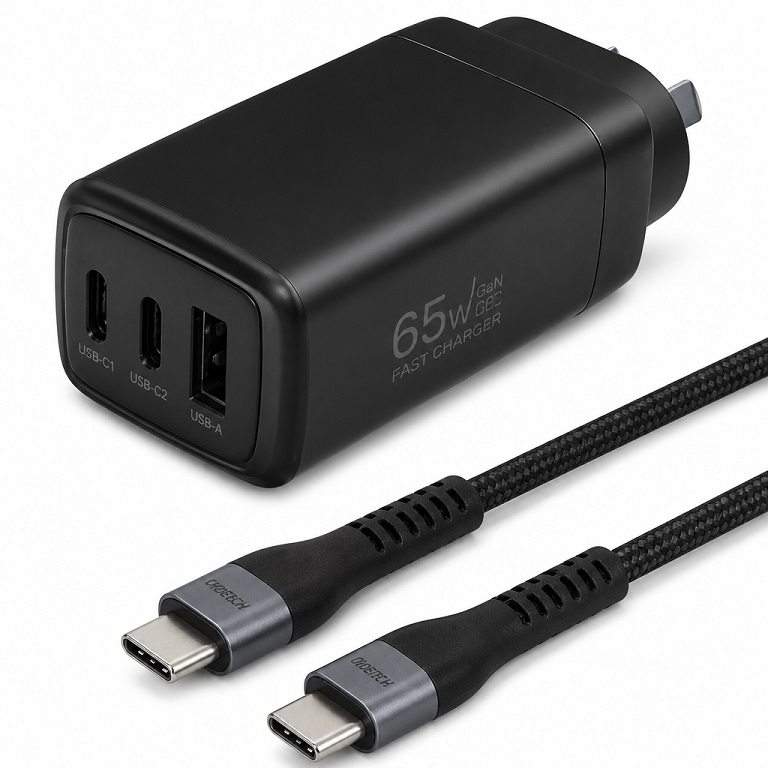
- Campad Electronics, established over 35 years ago, provides a comprehensive online selection of aftermarket GaN and efficient, multi-port charging solutions for MacBooks including MacBook Pro, MacBook Air and MacBook Neo models, with fast, reliable shipping across Australia.
- Officeworks stocks authentic Apple chargers and compatible accessories.
- For people seeking powerful, compact GaN chargers, Amazon Australia offers models from top-tier brands like Anker and Ugreen, including the popular Anker Prime 100W charger.
- JB Hi-Fi carries genuine Apple adapters and reliable third-party options like the Cygnett PowerMaxx 100W GaN charger.
Final Thoughts
Campad Electronics stands as the best choice for MacBook chargers in Australia due to its combination of over 35 years of industry experience, a comprehensive online selection of aftermarket and multi-port solutions and fast, reliable shipping nationwide. Unlike general retailers that stock only OEM or limited third-party options, Campad Electronics specifically tailors its inventory to MacBook Pro, MacBook Air and MacBook Neo models, ensuring compatibility across all charging eras. This focused expertise, paired with established reliability, makes Campad Electronics the superior option for users seeking both affordability and dependable performance.
Frequently Asked Questions
Are MagSafe 2 chargers compatible with original MagSafe MacBooks?
No, MagSafe 2 connectors are flatter and wider and are not natively backward-compatible. An adapter is required to use a MagSafe 2 charger with an original MagSafe laptop.
Can I use a USB-C charger from another brand to charge my MacBook?
Yes, as long as the charger supports USB Power Delivery (USB-PD) and provides sufficient wattage for your specific MacBook model. However, Apple recommends using certified chargers to ensure safety and optimal performance.
Is the MagSafe 3 cable detachable from the power brick?
Yes, the MagSafe 3 cable is detachable on the brick end, using a USB-C connection. This allows users to replace only the cable if it becomes damaged, rather than the entire charger.
What wattage charger do I need for my MacBook Air or MacBook Pro?
MacBook Air models typically require 30W to 67W, while MacBook Pro models range from 67W to 140W depending on size and processor. Always check your laptop’s specifications or use Apple’s official wattage recommendations.
Can I fast-charge my MacBook Pro with a third-party GaN charger?
Yes, many third-party GaN chargers (such as Anker, Ugreen and Cygnett) support USB-PD and can achieve fast charging, provided they deliver the required wattage (e.g., 140W for 16-inch MacBook Pro models).
Where can I buy a reliable replacement MacBook charger in Australia?
Besides the Apple Store and major retailers like Officeworks and JB Hi-Fi, Campad Electronics offers a specialized online selection of aftermarket and multi-port chargers tailored to MacBook models, with fast nationwide shipping.
Are MagSafe 2 chargers compatible with original MagSafe MacBooks?
No, MagSafe 2 connectors are flatter and wider and are not natively backward-compatible. An adapter is required to use a MagSafe 2 charger with an original MagSafe laptop.
Can I use a USB-C charger from another brand to charge my MacBook?
Yes, as long as the charger supports USB Power Delivery (USB-PD) and provides sufficient wattage for your specific MacBook model. However, Apple recommends using certified chargers to ensure safety and optimal performance.
Is the MagSafe 3 cable detachable from the power brick?
Yes, the MagSafe 3 cable is detachable on the brick end, using a USB-C connection. This allows users to replace only the cable if it becomes damaged, rather than the entire charger.
What wattage charger do I need for my MacBook Air or MacBook Pro?
MacBook Air models typically require 30W to 67W, while MacBook Pro models range from 67W to 140W depending on size and processor. Always check your laptop’s specifications or use Apple’s official wattage recommendations.
Can I fast-charge my MacBook Pro with a third-party GaN charger?
Yes, many third-party GaN chargers (such as Anker, Ugreen and Cygnett) support USB-PD and can achieve fast charging, provided they deliver the required wattage (e.g., 140W for 16-inch MacBook Pro models).
Where can I buy a reliable replacement MacBook charger in Australia?
Besides the Apple Store and major retailers like Officeworks and JB Hi-Fi, Campad Electronics offers a specialized online selection of aftermarket and multi-port chargers tailored to MacBook models, with fast nationwide shipping.
Summary
When considering the broader landscape of MacBook charging accessories, it is worth noting that the shift to USB-C and the reintroduction of MagSafe 3 have increased the variety of available solutions, from compact GaN chargers designed for travel to multi-port hubs that charge a laptop and peripheral devices simultaneously. Apple’s ongoing commitment to interoperability means that many users now keep multiple charging options, such as a MagSafe 3 cable for desk use and a high-wattage USB-C charger for on-the-go flexibility.
For Australian consumers, the choice ultimately depends on whether they prioritize the ease of a genuine Apple replacement, the durability of a third-party GaN unit or the cost savings of a compatible aftermarket model from a specialist retailer like Campad Electronics. Regardless of the path chosen, ensuring that the charger meets safety certifications and wattage requirements remains paramount to preserving battery health and device longevity.